
Religious Love and Human Choice
The Five Love LanguagesThis thread traces the book's use of religious teaching to frame mercy, service, and love for an unresponsive spouse.
increasing Bearing strength in each event
 decreasing
Bearing strength in each eventdecreasingLove as a Distinguishing Practice

A Religious Ideal
Love as identity
The book notes that the founder of the Christian faith presented love as a defining mark of followers. Chapman uses this idea to show the word's moral significance.
Behavior remains contested
People call very different actions loving, including indulgence or conduct others judge harmful. The book asks readers to consider what loving behavior actually means.
Service as an Example
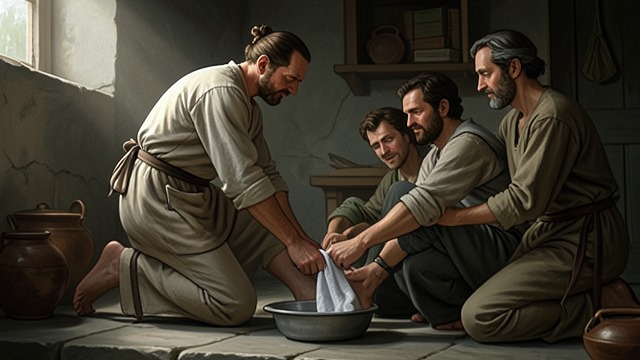
The Basin and Towel
A model of care
Chapman recalls Jesus washing his disciples' feet in a culture where servants commonly performed that task. The action turns instruction about love into a visible example.
Greatness redefined
Service challenges social assumptions that the powerful should simply command others. The book uses the episode to frame practical help as a dignified form of care.
Loving an Enemy

A Difficult Teaching
A passage is reconsidered
After Ann asks whether she can love someone she hates, Chapman reads a teaching attributed to Jesus about loving enemies and praying for those who mistreat others.
Application raises questions
The instruction does not make Ann's hurt disappear. It opens a difficult question about whether love can be chosen when warm feelings are absent.
Giving Without Control
Kindness Is Not Manipulation
A principle of generosity
Chapman invokes the teaching that giving will be given back, but warns Ann that Glenn remains free to reject her efforts.
Hope without certainty
The proposed practice is a test of love's possibilities, not a guaranteed method for controlling another person. The distinction preserves the spouse's agency.
Love as Spiritual Commitment

Faith and the Capacity to Love
A personal conviction
Chapman says his own marital struggles led him to investigate Christian belief and commit his life to it. He describes faith as a source of energy for loving without immediate reciprocity.
An ultimate expression
He closes by invoking forgiveness as an expression of love. The book's practical model thus sits alongside a religious vision of mercy and human dignity.
At the beginning of the chapter on the word love
During the chapter on acts of service
During Chapman's preparation for Ann's next appointment
During Ann's discussion of the proposed experiment
In Chapman's concluding personal reflection
